
Review · CHINA
4-Hr Shanghai Tour: Food, Culture, Sightseeing, Cycling, Ferry
Shanghai is easiest to understand when you move through it at street level. This private four-hour tour links skyscraper views, a commuter ferry, a temple, shared bicycles, neighborhood food, and tea, giving you several different versions of the city in one compact outing. You begin near Lujiazui and finish in Hongkou, so the route feels like a cross-city portrait rather than a single sightseeing stop.
I like two things in particular. First, the ferry ride gives you a low-cost, everyday view of the Huangpu River, with construction cranes and towers sharing the same skyline. Second, the tour does not stop at big sights. The tea ceremony, snacks at City Mart, and visit to Xiahai Temple bring in small details of local life that a tower visit alone cannot provide.
The main consideration is pace. The schedule covers six stops in about four hours, and the cycling uses urban shared bikes. You need to be comfortable changing modes, keeping to time, and riding a bike that may not suit everyone.
Key points to know before booking
- Six stops in four hours: Expect a brisk route with little wasted time, but not long, leisurely visits at every stop.
- A ferry instead of a sightseeing cruise: You ride public transport across the Huangpu River, seeing the city as commuters do.
- Shanghai Tower is optional: The observation deck is not included and costs CN¥180 per person.
- Food and tea are built in: City Mart snacks, an ethnic tea ceremony, and one bottled water are included.
- Shared bikes shape the experience: The supplied bicycles are urban shared bikes, so choose this tour only if you are comfortable riding them.
- Private English-speaking guide: Your group participates on its own, with no unrelated participants joining you.
A street-level introduction to modern Shanghai
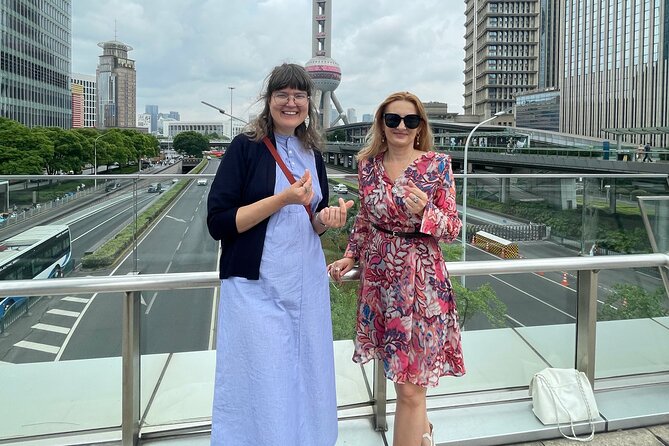
The tour begins at Lujiazui subway station in Pudong, one of the city’s clearest symbols of rapid change. This is the district of high towers, broad views, and constant construction. Your guide leads you around the area, pointing out sightlines and giving you a better sense of how the financial center fits into Shanghai.
The first stop is Shanghai Tower, where an observation deck visit is optional. If you pay the additional CN¥180 entry fee, you can look over the metropolis from above. That view may be worth it to you if this is your first visit or if you want a classic skyline photograph.
Still, the tower is not essential to the tour’s main idea. Admission is not included, and the experience already gives you several good city views at street level and from the river. I would treat the observation deck as an add-on, not as the reason to book the tour.
The Lujiazui portion is also a useful orientation stop. Instead of seeing Shanghai as a wall of anonymous skyscrapers, you begin to notice the contrast between new office towers, transport links, and the older parts of the city across the river.
More Ferry and Bike Tours in the world:
- From Perth: Rottnest Island Full-Day Bike and Ferry Trip
★ 4.7 · 2,548 reviews - From Fremantle: Rottnest Island Ferry and Bike Day Tour
★ 4.6 · 805 reviews - From Perth: Rottnest Island Ferry & Bike Trip
★ 4.5 · 627 reviews
The Huangpu River by commuter ferry
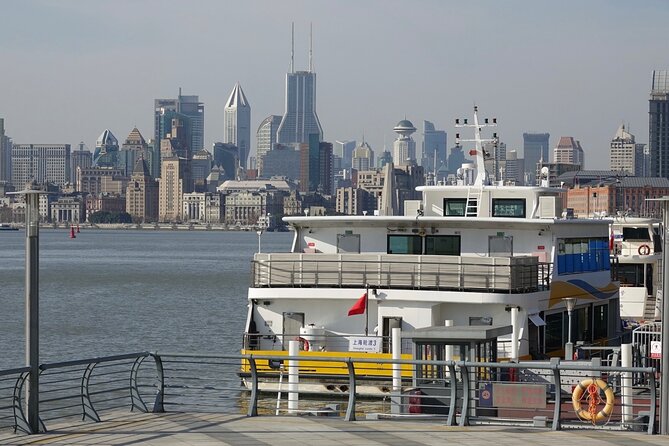
The 45-minute Huangpu River segment is one of the tour’s most appealing choices. This is a commuter ferry, not a dedicated sightseeing boat. You get a practical ride with a local feel, while the skyline slides past at a relaxed pace.
From the water, Shanghai’s present and future sit side by side. Tall hotels and office buildings rise near construction cranes, making it clear that the city is still being rebuilt and reshaped. At the same time, the ferry itself offers a simple, familiar way to cross the river.
I prefer this kind of transport to a polished cruise when the goal is to understand a city. The ferry is included in the tour, and it adds a real transportation experience rather than another ticketed attraction. It also breaks up the walking and cycling, which matters on a warm day.
Do not expect a narrated cruise with a long list of monuments. The value is in the movement, the view, and the sense of joining ordinary city traffic for a short ride.
Xiahai Temple and Shanghai’s sea goddess
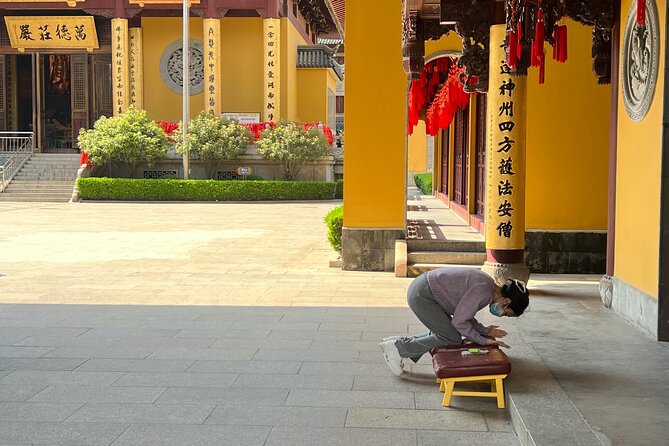
After the modern towers and ferry, Xiahai Temple changes the mood. The visit lasts about 35 minutes and is included in the price. The temple was originally built to honor Mazu, the Chinese sea goddess believed to protect fishermen and sailors.
That background gives the stop more weight than a quick photo visit. The temple is tied to Shanghai’s relationship with water, trade, and the people who depended on the sea. Its traditional architecture offers a sharp contrast to the glass towers of Lujiazui.
I like the way this stop broadens the tour beyond modern Shanghai. You get a quiet place for a short pause, along with an introduction to worship, local custom, and older building traditions. The visit is not long enough for an extended religious or architectural study, but it is enough to reset the rhythm of the afternoon.
Your guide can also help place the temple in the wider route. After seeing the city’s financial future, you are looking at a part of Shanghai that carries older beliefs and customs forward.
Shared bikes and a changing city
Cycling is one of the tour’s main ways to cover ground. The bikes provided are urban shared bikes, and the route uses them to connect parts of the city that would take longer on foot. The experience is less formal than sitting on a tour bus, and you get a closer look at streets, buildings, and daily movement.
One review praised the combination of walking and biking, even in high temperatures. That is useful advice: the cycling adds energy and variety, but hot weather can make the four-hour schedule feel more demanding.
You should also read the bike detail carefully. These are shared urban bicycles, not necessarily specially fitted touring bikes. If you have concerns about balance, comfort, traffic, or physical effort, tell the operator when booking and consider if this is the right outing for you.
The cycling helps express the tour’s central theme: Shanghai is changing fast, but it has not erased every older layer. You move through a city where preserved homes, new towers, small shops, temples, and transport infrastructure can all appear within the same afternoon.
More food and drink stops in the world:
- Istanbul: Guided Food Tour with Ferry Ride and Tastings
★ 4.9 · 770 reviews - San Francisco Combo: Ferry Building Food Tour and Alcatraz
★ 4.5 · 152 reviews - Victoria Bites and Sights Tour with Food, Drinks and Ferry
★ 4.8 · 114 reviews - San Francisco Food Tour: Ferry Building and Ferry Plaza Farmers Market
★ 4.5 · 92 reviews
City Mart and the taste of neighborhood Shanghai
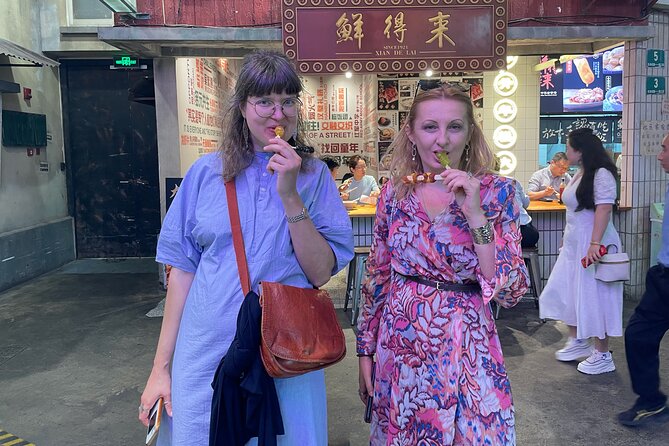
At Raffles City Mall, the tour turns toward food and urban memory. City Mart is presented as an example of how older Shanghai homes and shops can remain part of the city even as redevelopment continues. Here, you taste signature snacks and get a closer look at the food habits of Shanghai neighborhoods in the late 20th century.
This is a modest food stop, not a full meal. That distinction matters. You should avoid eating too heavily before the tour, because bites and sips are included along the way. If you arrive expecting a long restaurant lunch, you may be disappointed. If you want small tastes tied to local life, the stop fits well.
Food is especially useful here because it makes the city’s social history easier to grasp. Buildings and dates can feel distant. A familiar snack, a restored shop, or a market shelf gives you something concrete to connect with.
Dietary restrictions should be shared at the time of booking. The operator specifically asks for this information, along with any accessibility needs or requests for assistance.
Tea at the North Bund
The North Bund stop focuses on tea as a social habit. You take part in an ethnic tea ceremony and have time for a cup of tea in a setting designed for contact with local customs and etiquette.
This is not simply a beverage break. Tea carries rules about serving, receiving, pace, and hospitality. The ceremony gives you a short introduction to those customs in a relaxed setting, and it adds a human element after the bigger sights.
The North Bund also gives the tour another view of Shanghai’s changing waterfront. You have already seen the river from a ferry, but arriving in this area provides a different angle on the city’s development. The route ends in Hongkou, near the North Bund, so the final portion does not require returning to Pudong.
The included food and tea make the $93 price easier to assess. You are paying for a private guide, public transport, temple entry, tea, snacks, and water, not just a series of photo stops. The value is strongest if you want interpretation and variety in a short window.
A final café stop in Hongkou
The final 20 minutes take place at a café near notable landmarks in Hongkou. It is a small closing stop, but it gives you room to slow down after the ferry, walking, temple visit, and cycling.
The café is free to enter, while personal expenses are not included. You should expect to pay for anything extra you order. Its purpose is less about a major attraction and more about ending in a neighborhood setting instead of at a large transport terminal or an observation deck.
The tour finishes in Hongkou near the North Bund, close to public transportation and taxi stands. The starting point at Lujiazui subway station is also convenient, so the route is practical if you are planning other sightseeing before or after the tour.
What the $93 price really covers
At $93 per person, this is not the cheapest way to see Shanghai. It is also not a standard bus tour. The price pays for a private English-speaking guide and a multi-part route using bike, ferry, subway, and foot.
Included services are:
- Private English-speaking guide
- Public transportation by bike, ferry, and subway
- Entry to Xiahai Temple
- Ethnic tea ceremony
- Bites and sips
- One bottled water per person
The Shanghai Tower observation deck is separate, at CN¥180 per person. Hotel pickup and drop-off are not included, and tips, personal spending, and extra café purchases are also your responsibility.
For a solo visitor, $93 may feel high compared with using public transport alone. For a small group, the private format and available group discounts can make the cost more reasonable. You are paying for a planned route and context, not merely for the rides.
The strongest value comes from the mix. A ferry-only outing would cost less. A self-guided visit to Lujiazui and Xiahai Temple would also cost less. But assembling the same combination of cycling, snacks, temple entry, tea, and cross-river transport would take planning and time.
Timing, comfort, and practical concerns
The tour lasts about four hours, with listed stop times of one hour at Shanghai Tower, 45 minutes on the Huangpu River, 35 minutes at Xiahai Temple, 45 minutes at Raffles City Mall, 35 minutes at the North Bund, and 20 minutes in Hongkou.
That adds up to a full schedule before counting movement between stops. You should expect an active outing rather than an unhurried half-day walk. Keep your belongings light, wear comfortable shoes, and be ready to move when the guide sets off.
The guide will not wait more than 10 minutes after the scheduled start time. Arrive at Lujiazui subway station early, especially if you are unfamiliar with Shanghai’s metro system.
Under-16 participants must be accompanied by a parent or guardian. Service animals are allowed, and the route is near public transportation. Most people can participate, but cycling and frequent movement may not suit every physical ability.
The operator may change the route because of poor weather or an inaccessible location. The experience requires good weather, and a cancellation for that reason gives you the choice of another date or a full refund.
Free cancellation is available if you cancel at least 24 hours before the start time. Cancellations or changes within 24 hours are not refunded or accepted.
Who will enjoy this Shanghai tour most
I would choose this experience if you have limited time and want more than a skyline photograph. It works well for a first visit, especially if you want one afternoon to cover modern architecture, traditional worship, food, tea, and neighborhood streets.
It also suits people who like active sightseeing. The mix of ferry, bike, subway, and walking keeps the afternoon moving. You will not spend hours in one museum or attraction.
Families with older children may enjoy the transport changes and cycling, provided everyone meets the age and mobility requirements. Couples and small groups can also benefit from the private format, particularly if they want to ask questions or adjust the pace within the fixed schedule.
I would think twice if you dislike shared bikes, prefer long visits at each attraction, or want a serious food tour with full meals. The route is broad rather than specialized. It gives you several tastes of Shanghai, but none of them becomes an extended study.
Should you book it?
Book this tour if you want a compact, active introduction to Shanghai that connects the city’s new towers with older customs and everyday transport. The ferry, Xiahai Temple, City Mart snacks, and tea ceremony give it more character than a skyline-only outing.
Skip it if your priority is Shanghai Tower, since its admission costs extra, or if you want a slow-paced day with plenty of time at each stop. For everyone else, the private guide, included transport, food, tea, and North Bund finish make the $93 price reasonable, especially when shared across a group.
FAQ
How long does the Shanghai tour last?
The experience lasts approximately four hours.
Where does the tour start?
It starts at Lujiazui subway station in Pudong, Shanghai.
Where does the tour finish?
It finishes in Hongkou near the North Bund, at a location close to public transportation and taxi stands.
Is Shanghai Tower admission included?
No. Shanghai Tower admission is optional and costs CN¥180 per person.
Is transportation included?
Yes. Public transportation by shared bike, ferry, and subway is included.
Is the ferry ride included?
Yes. The Huangpu River commuter ferry ride is included.
What food and drink are included?
The tour includes bites and sips, an ethnic tea ceremony, and one bottled water per person.
Is this a private tour?
Yes. Only your group participates in the activity, with one private English-speaking guide.
What happens if bad weather cancels the tour?
You will be offered a different date or a full refund if the experience is canceled because of poor weather.
More food tours in the world
- City Tour with Food Stop at Ferry Building + Optional Alcatraz
★ 5.0 · 79 reviews - Boston: Historic Pubs Walking & Ferry, Food & Drink Tour
★ 4.9 · 56 reviews - Food & Drink Private Tour in Lisbon & Cacilhas w/ Ferry Included
★ 5.0 · 14 reviews - Istanbul: Guided Food Tour with Ferry Ride
★ 4.9 · 13 reviews
Latest sailings added in the world
- Private Tangier Tour from Ferry /Cruise ship Including Lunch★ 3.8 · 12 reviews
- Lake Como: Villa Carlotta Entry Tickets with Ferries★ 4.1 · 5 reviews
- NYC: Brooklyn Bridge and DUMBO Tour with East River Ferry★ 4.9 · 28 reviews
- Lake Como: Lakeside Villas Entry Tickets with Ferries★ 4.2 · 77 reviews
- Old Town Alexandria in a Day with Round Trip Ferry Cruise★ 4.5 · 17 reviews
- Vancouver False Creek Ferry Tour★ 5.0 · 32 reviews
- Victoria & Butchart Gardens Tour with Gulf Island Ferry★ 4.0 · 7 reviews
- Photography, Hiking & Ferry to Bowen Island★ 5.0 · 29 reviews
Ferry and Bike Tours, compared.
From Perth: Rottnest Island Full-Day Bike and Ferry Trip
Read our review →
From Fremantle: Rottnest Island Ferry and Bike Day Tour
Read our review →

San Francisco: Electric Bike Rental w/ Map & Optional Ferry
Read our review →
Rottnest Island Fast Ferry from Hillarys Boat Harbour Including Bike Hire
Read our review →
Golden Gate Bridge Bike Rentals with Optional Ferry Return
Read our review →Find it on these lists