
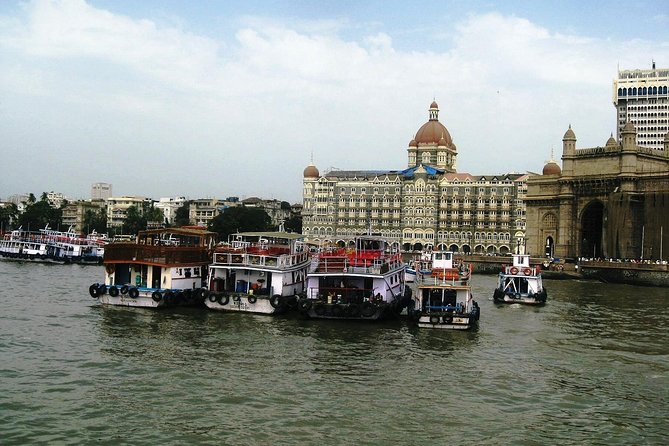
Review · MUMBAI
All in one-Combo of City, Dhobighat, Slum & Dabbawala with ferry and train ride.
Mumbai’s working life is the heart of this full-day outing. In one long day, you move from the grand stonework of Chhatrapati Shivaji Terminus to the sorting rush of the dabbawalas, the concrete wash pens of Dhobi Ghat, and the homes and workshops of Dharavi. The ferry and train rides add a useful sense of how the city actually moves.
I like the range here. You get major sights, working neighborhoods, and local transport rather than only a drive past monuments. I also like that the tour is private, includes an English-speaking guide, lunch, entry fees, and an air-conditioned vehicle. The main drawback is the pace: eight stops in 7 to 10 hours can feel packed, and Dharavi requires a moderate level of fitness.
Key points at a glance
- One day, many sides of Mumbai: Combine monuments, coastline, rail travel, laundry work, lunch delivery, and Dharavi in one outing.
- Real local transport: Ride a ferry from Colaba and take a train from Churchgate while learning how Mumbai commuters get around.
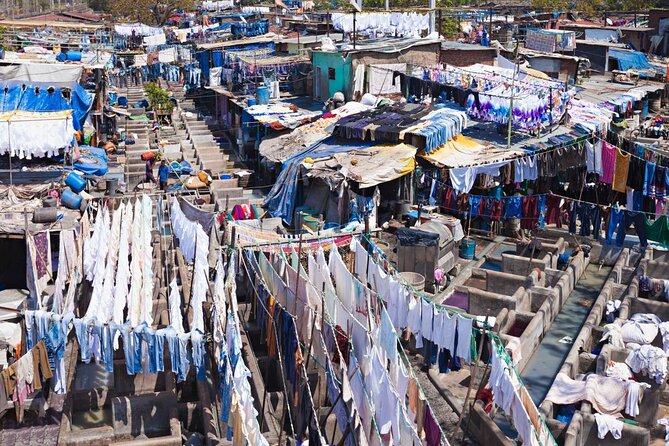
- Working-city focus: See dabbawalas handling lunch boxes and visit Dhobi Ghat, where laundry is washed, dried, pressed, and sorted.
- Private tour format: Only your group participates, with pickup offered and an air-conditioned vehicle for the road sections.
- Useful for a short stay: The itinerary covers major South Mumbai sights plus Dharavi without requiring several separate bookings.
- Plan for a long day: The advertised duration is about 7 to 10 hours, with walking at Dharavi and several quick sightseeing stops.
Why this Mumbai combination works
This is not a slow, single-theme tour. It is a broad first look at Mumbai, designed for someone who wants to understand the city quickly. You see the imperial face of South Mumbai, the Arabian Sea waterfront, and the informal economy that keeps daily life moving.
The strongest part is the contrast. At CST, you see elaborate colonial-era architecture and one of the world’s busiest railway stations. Later, at Churchgate, you watch a low-tech lunch delivery system built on timing, teamwork, and human sorting. Dhobi Ghat offers another working system, this time based on hereditary laundry work.
The tour also avoids making the city feel like a collection of monuments. The ferry, train, lunch, and walking sections connect the sights to everyday Mumbai. You are not simply looking at the city. You are seeing how people travel, work, wash clothes, and use crowded urban space.
That breadth comes with a trade-off. You will not have a long, relaxed visit at each stop. The scheduled visits at CST, Marine Drive, the Gateway of India, and Mani Bhavan are short. I would choose this experience for coverage and context, not for quiet museum time or detailed architectural study.
More train and ferry trips in the world:
- From Rome: Positano & Amalfi Coast Day Trip by Train & Ferry
★ 4.6 · 225 reviews - Amalfi Coast by Train & Ferry with Smart Digital Guide
★ 4.3 · 37 reviews - Cinque Terre by train and boat (no ferries in winter)
★ 5.0 · 17 reviews
CST, where Mumbai’s railway story begins
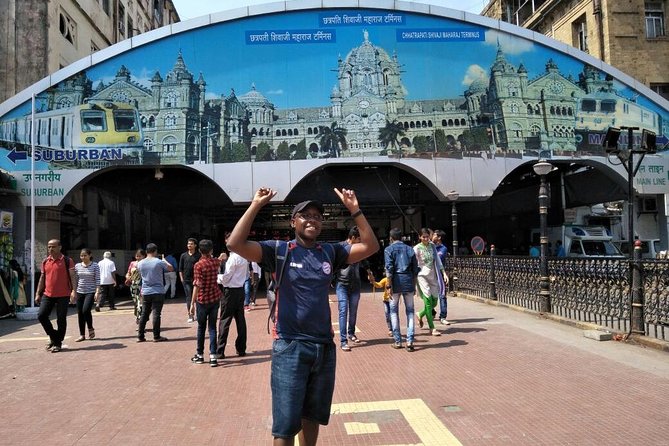
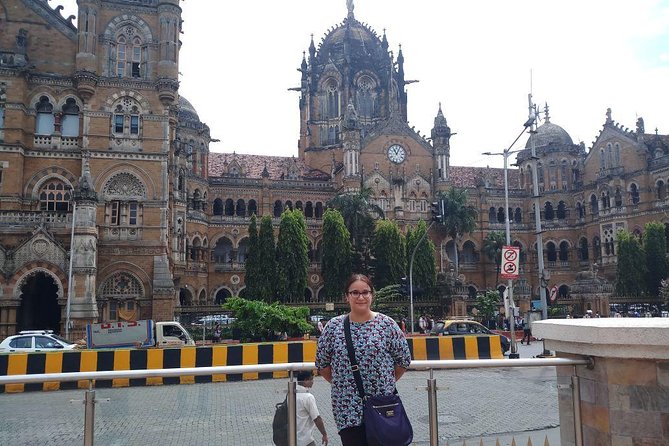
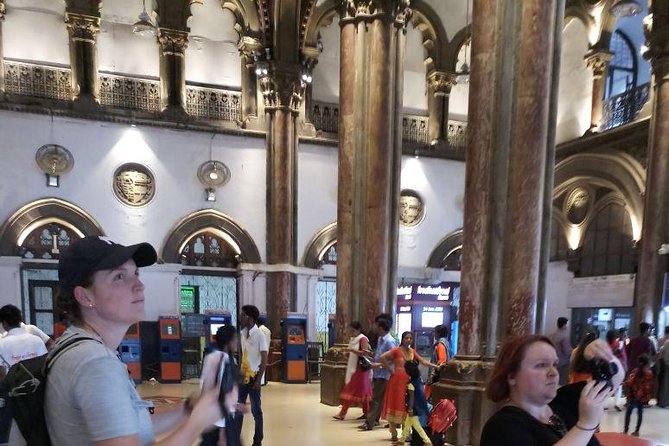
The first stop is Chhatrapati Shivaji Terminus, still widely known as Victoria Terminus. Its design draws on Gothic architecture, with carved stone decoration, stained glass, flying buttresses, and a central dome topped by a figure representing Progress.
You have about 20 minutes here, with admission included. That is enough to appreciate the exterior and understand why the building matters, but not enough for a leisurely inspection of every carved detail. Keep your expectations practical. This is a focused stop at a major landmark, not a full station tour.
The setting gives the building extra force. CST is not an isolated monument. It remains a working railway station used by about 2.5 million commuters each day. Electric trains have replaced the early steam engines, but the station still functions as part of Mumbai’s daily pulse.
I like that the tour places this grand building beside the later train ride. You first see Mumbai’s railway identity in stone, then experience it at ground level as public transport.
Marine Drive and the Arabian Sea
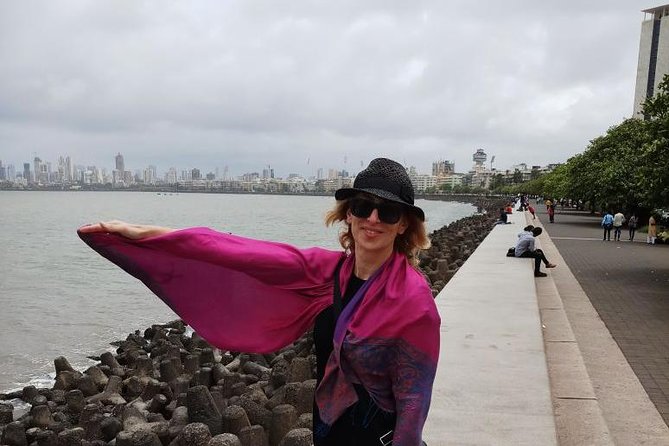
Marine Drive gives you a short break from buildings and traffic. The six-lane boulevard follows a roughly three-kilometer curve along Mumbai’s natural bay, linking Nariman Point with Malabar Hill.
The planned stop lasts about 25 minutes and is free to enter. You have time to walk along the esplanade, look across the Arabian Sea, and take in the broad coastal view. If the schedule permits, this is also one of the simpler places to pause for photographs.
This is a scenic stop rather than a guided attraction with an admission gate. The value is in seeing how Mumbai uses its waterfront. The road and promenade give residents room to walk, meet, and watch the sunset, and they offer you a clear change of mood after CST.
The limitation is weather. The experience requires good weather, and coastal views can lose some of their appeal in poor conditions. The tour can offer another date or a full refund if bad weather causes cancellation.
The Gateway of India and Colaba’s waterfront
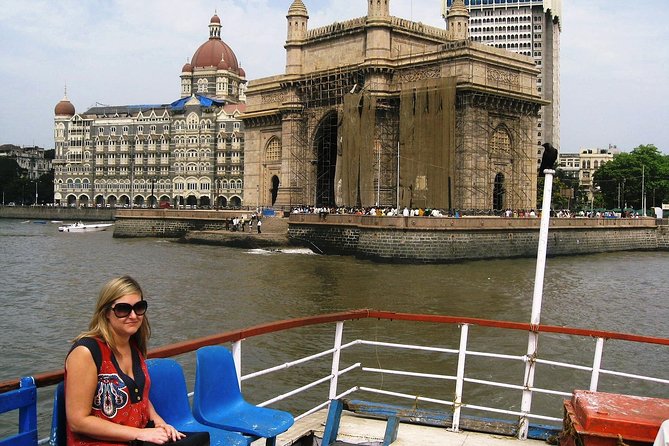
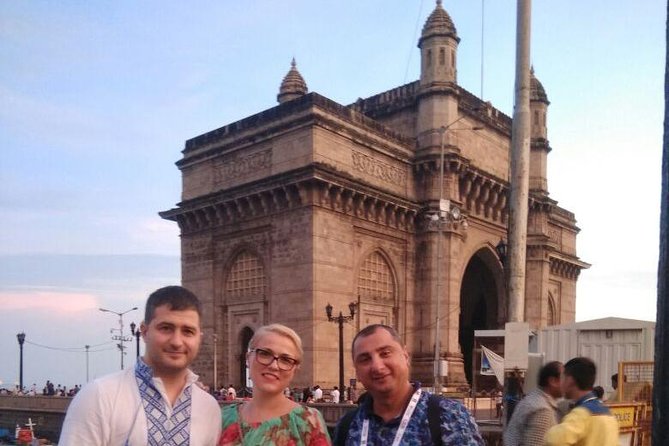
The Gateway of India is Mumbai’s best-known monument and a natural point of orientation for the waterfront. Built from yellow basalt, the triumphal arch was created for the visit of King George V and Queen Mary. It later gained a different meaning when the last British ships leaving India departed from here in 1947.
You have about 25 minutes at the monument, with no admission fee. The arch, four turrets, carved latticework, and steps leading toward the water give you plenty to see in a short visit. It can also be a crowded public place, so your guide’s meeting instructions matter.
The Gateway is a good example of Mumbai’s layered identity. It began as a colonial symbol and is now used and enjoyed as an Indian public landmark. That change in meaning is worth noticing as you look beyond the formal stonework.
Afterward, you go to the ferry point at Apollo Bunder in Colaba. The ferry ride lasts about 20 minutes and cruises along the city’s coastline. This is a modest boat outing, not a long harbor cruise, but it gives you a different angle on Mumbai and breaks up the road portions of the day.
More Ferry Trips in the world:
- New York City: Statue of Liberty & Ellis Island with Ferry
★ 4.6 · 18,683 reviews - All Inclusive Blue Mountain,Scenic World,Lunch,Koalas,ferry
★ 5.0 · 7,832 reviews - Muir Woods and Sausalito (Return by Bus or Ferry)
★ 4.5 · 5,098 reviews - Blue Mountains Small-Group Tour from Sydney with Scenic World,Sydney Zoo & Ferry
★ 5.0 · 3,709 reviews
Mani Bhavan and Gandhi’s Mumbai years
Mani Bhavan is a two-story house linked to Mahatma Gandhi’s time in Mumbai. It now contains a reference library with more than 2,000 books, a photographic display, and personal items including a spinning wheel.
The visit is scheduled for about 20 minutes, with admission included. That makes this another concise stop. You can see the rooms and displays, but you will need to move at a steady pace rather than read every item in depth.
I like the human scale of Mani Bhavan after the size of CST and the Gateway. The building offers a quieter look at Gandhi’s work and daily life. The spinning wheel is a particularly direct object, connecting political ideas with a simple tool used by hand.
If Gandhi is a major reason for your visit to Mumbai, you may want more time than this tour allows. If you want a compact introduction, the stop fits well into the larger route.
Churchgate and the dabbawala system
The dabbawala section is one of the most useful parts of the day because it links Mumbai’s transport network to its office culture. A dabbawala collects a freshly prepared lunch from a home and delivers it to an office worker, then returns the empty container.
At Churchgate Railway Station, you watch the activity and take a train ride. The scheduled time is about 50 minutes, including the railway experience. This is not a staged performance. The interest comes from seeing people coordinate a daily service with very little technology.
The system depends on teamwork and strict timing. Lunch boxes move through a network of collectors, sorters, and delivery workers, with the train system helping make the route possible. You get a better sense of the method when you are actually near the station and on the train rather than hearing about it from a vehicle.
This part also asks you to be alert. A railway station is a working public space, not a quiet exhibit. Follow your guide’s instructions, keep your belongings secure, and expect the pace to be brisk.
Dhobi Ghat, Mumbai’s open-air laundry
Dhobi Ghat is one of Mumbai’s most unusual working sites. Dhobis collect dirty clothes, wash them in concrete pens, dry them, press them, and return them to customers. The work has traditionally passed through families, and nearly 200 dhobis and their relatives work together in the area.
The 35-minute visit includes admission. You see rows of wash pens, flogging stones, vats, drying areas, and neatly piled bundles. The process is physical and direct: clothes are soaked, beaten clean, treated with starch, dried, ironed, and sorted.
This stop matters because it shows a service most people normally encounter only at the end, when clean clothing arrives at a door. Here you see the labor and organization behind it. It is also a place where respectful behavior matters. Listen to your guide, avoid treating people as scenery, and follow any instructions about where you may walk or take photographs.
The short time means you will get an overview rather than a full account of the laundry economy. Still, it is enough to understand why Dhobi Ghat is a distinctive part of Mumbai.
Walking through Dharavi’s homes and workshops
The Dharavi portion lasts about one hour and takes place on foot. You see both residential and commercial areas inside one of Asia’s largest slum districts.
This is the most sensitive stop, and it needs the right attitude. Dharavi is not simply a poor neighborhood for outsiders to inspect. It is also a place where people live and work, with commercial activity operating alongside homes. The value of the walk comes from learning about that mixed urban life, not from collecting dramatic photographs.
Your guide provides the context, while you need to remain polite and aware of personal space. Dress and behave as you would in any residential area. The provided information does not set out a specific photography policy, so ask your guide before taking pictures.
The walk requires moderate physical fitness. You should be ready for an hour on foot after several earlier stops, a ferry, and a train ride. Anyone who prefers a short vehicle-based sightseeing route may find this section demanding.
Lunch, transport, and the $85 value
The price is $85 per person. The package includes an air-conditioned vehicle, an English-speaking guide, a budget Indian lunch, ferry and train elements, admission fees, and all taxes. Pickup is offered, and the activity is private, meaning only your group takes part.
That price can make sense if you want to combine several separate Mumbai experiences in one day. Booking individual visits, arranging transport between South Mumbai, Churchgate, Dhobi Ghat, and Dharavi, and finding a guide for the working-city sections could take more time than you want to spend.
The value is less obvious if you plan to use Mumbai public transport independently and visit only a few free sights. Marine Drive and the Gateway of India do not charge admission, and the itinerary gives some stops only 20 to 25 minutes. You are paying mainly for coordination, a private guide, transport, included activities, and the ability to cover a wide area.
The lunch is described as a budget Indian meal. It is practical fuel for a long day, not a special food experience. Alcohol is not included.
Timing, pickup, and the pace of the day
Expect the experience to last roughly 7 to 10 hours. The wide time range reflects Mumbai traffic, the number of stops, and the movement between road, ferry, and train sections.
Pickup is offered, which can be helpful when you are arriving by ship or staying outside the immediate sightseeing area. A useful example comes from a booking affected by a one-hour ship delay: the guide, Gurrit, kept in regular contact, reassured the group, met them at the port, and worked with the driver to cover the planned sights in good time.
That does not guarantee the same guide or the same traffic conditions, but it shows why communication matters on a Mumbai day tour. Give accurate pickup details and keep your phone available before departure.
The tour allows service animals and is near public transportation. You need moderate physical fitness, especially for the Dharavi walk and the train portion. A private format may also help if your group needs a little flexibility, though the full route remains busy.
Who should book this experience?
I would choose this tour if you have one free day in Mumbai and want a structured introduction to both famous sights and ordinary work. It suits first-time visitors, cruise passengers, and groups that value a private guide over arranging several rides and visits themselves.
It is also a strong match if you are curious about systems: how people commute, how lunches move across the city, how laundry is processed, and how homes and workshops share limited space.
I would hesitate if you want slow photography, long museum visits, or a relaxed beach day. The itinerary is ambitious. You will see a lot, but you will not linger.
Should you book the Mumbai all-in-one tour?
Book it if your priority is range. For $85, you get a private, guided day that links CST, Marine Drive, the Gateway of India, Mani Bhavan, Colaba, Churchgate, Dhobi Ghat, and Dharavi with a ferry, train ride, lunch, and road transport.
Skip it if you prefer to set your own pace or if an hour of walking through Dharavi does not suit you. For most people with limited time, though, this is a practical way to meet Mumbai through its landmarks and its working systems, not just its postcard views.
FAQ
How long does the tour last?
The tour lasts approximately 7 to 10 hours.
How much does the tour cost?
The listed price is $85 per person.
Is pickup available?
Yes, pickup is offered.
Is the tour private?
Yes. Only your group participates in the activity.
Is lunch included?
Yes. A budget Indian meal is included.
Is transportation included?
Yes. The tour includes an air-conditioned vehicle, a ferry ride from Colaba, and a train ride connected with the dabbawala visit.
Does the tour visit Dharavi?
Yes. The Dharavi section is a one-hour walking tour covering residential and commercial areas.
How physically demanding is the experience?
Participants should have a moderate level of physical fitness. The itinerary includes walking inside Dharavi and a train ride.
What happens if bad weather cancels the tour?
If poor weather causes cancellation, you will be offered another date or a full refund.
Can I cancel for a full refund?
Yes, if you cancel at least 24 hours before the experience start time. Cancellations made less than 24 hours in advance are not refunded.
Latest sailings added in the world
- Private Tangier Tour from Ferry /Cruise ship Including Lunch★ 3.8 · 12 reviews
- Lake Como: Villa Carlotta Entry Tickets with Ferries★ 4.1 · 5 reviews
- NYC: Brooklyn Bridge and DUMBO Tour with East River Ferry★ 4.9 · 28 reviews
- Lake Como: Lakeside Villas Entry Tickets with Ferries★ 4.2 · 77 reviews
- Old Town Alexandria in a Day with Round Trip Ferry Cruise★ 4.5 · 17 reviews
- Vancouver False Creek Ferry Tour★ 5.0 · 32 reviews
- Victoria & Butchart Gardens Tour with Gulf Island Ferry★ 4.0 · 7 reviews
- Photography, Hiking & Ferry to Bowen Island★ 5.0 · 29 reviews
Train Experiences, compared.

From Rome: Positano & Amalfi Coast Day Trip by Train & Ferry
Read our review →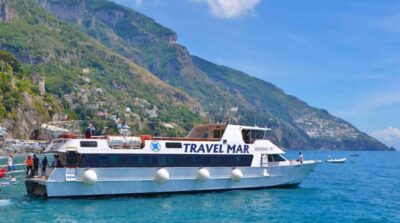

Cinque Terre by train and boat (no ferries in winter)
Read our review →Find it on these lists