
Review · USA
Harpers Ferry Audio Tour History, Ruins and River Views
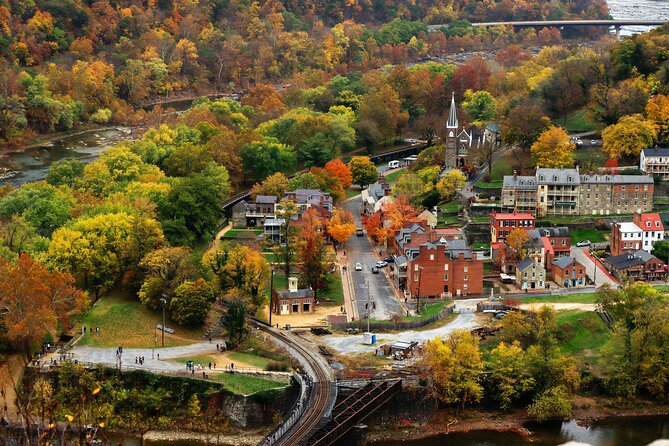
Harpers Ferry packs an astonishing amount of American history into a small, steep town. This self-guided walk takes you from the Appalachian Trail’s symbolic midpoint to John Brown’s Fort, Civil War overlooks, old industrial ruins, and the meeting point of two rivers.
I like the way the GPS audio starts when you reach each site, so you can stop to read markers and take in the views. I also like the freedom to set your own pace, with no guide or group to keep up with.
The catch is the walking. The route includes hills, stairs, and sites spread beyond Lower Town. One section may feel too steep if you have limited mobility, and the app’s map takes a little practice.
Key things to know before you go
- GPS-triggered storytelling: Audio begins as you reach many stops, helping you connect the place in front of you with its past.
- Nineteen historic stops: The route covers John Brown, Storer College, African American history, Civil War sites, industry, railroads, and river views.
- A real walking tour: Expect uphill stretches, the Appalachian Trail Staircase, and some distance between sites.
- Download before arrival: Cell service is spotty at best, so install the app and tour content ahead of time.
- Best value for independent visitors: At $9.99 per person, it gives you structure and context without paying for a private live guide.
- A few sites may be closed or limited: The African American history museum is currently closed for renovations, and the tour does not include admission tickets.
Starting at the Lower Town Train Station
The tour begins at the Lower Town Train Station at 182 Potomac Street. That is a sensible starting point because the station links Harpers Ferry’s past to its present. Trains still run here, and the building reminds you that this small town once served as an important rail connection.
You will use your phone as both map and guide. The app tracks your position and plays the appropriate narration near each stop. This is more useful than a basic recording because you do not have to guess which paragraph belongs to which building.
The best approach is to download the app and tour before you arrive. Cell service can be weak, and you do not want to spend your first minutes standing beside the station waiting for a file to load.
The route is private in the practical sense: only your group uses the tour. There is no fixed departure time, no live guide, and no need to match another group’s pace. The listed hours are 8 a.m. to 8 p.m., every day, from July 31, 2025, through March 6, 2027.
More history trips in the USA:
- Boston Historic Taverns Tour with Tastings and Ferry
★ 5.0 · 156 reviews - Boston: Historic Pubs Walking & Ferry, Food & Drink Tour
★ 4.9 · 56 reviews - Halifax: Georges Island National Historic Site Ferry Ticket
★ 4.9 · 28 reviews
Appalachian Trail stories and a steep first impression
The Appalachian Trail Conservancy Headquarters is an easy opening stop. The famous trail runs about 2,190 miles, and Harpers Ferry is treated as its symbolic midpoint. You will spend roughly ten minutes here learning why the town matters to hikers and how the trail connects distant parts of the eastern United States.
The stop helps set the tone for the walk. Harpers Ferry is not only a Civil War town. It is also a place where long-distance hiking, river travel, industry, transportation, and national politics meet.
The Appalachian Trail Staircase gives you a more physical sense of the trail. Cut into the hillside, it links Lower Town with the Appalachian Trail. It is scenic, but it is also steep. If you are not comfortable with uphill walking, plan to enjoy the easier Lower Town stops and treat the upper sections as optional.
African American history and Storer College
One of the most important themes on this route is the history of African Americans in Harpers Ferry. A dedicated museum tells stories of people who were enslaved, freed, educated, and determined to shape their own lives. The museum is currently closed for renovations, so you should not count on entering it during this tour.
That closure does not erase the subject from the walk. The route continues to Lockwood House and the former Storer College campus, where the story becomes especially powerful.
Lockwood House served Union officers and later housed leaders connected with Storer College. Storer College was founded after the Civil War to educate formerly enslaved people. Its campus became a place of learning, leadership, and civil rights work during Reconstruction.
I consider these stops essential because they keep Harpers Ferry from becoming only a John Brown and Civil War story. The town’s past also includes education, Black leadership, and the long work of building opportunity after slavery.
Harper Cemetery and the town above the rivers
Harper Cemetery sits above the town and offers a quieter pause. Soldiers, local residents, and other important figures are buried here, and the setting gives you wide views over Harpers Ferry.
The stop is brief, about five minutes, but that is enough to make the point. Harpers Ferry’s location gave it beauty, but also made it a prize in times of conflict. From above, the rivers and ridges explain why armies, rail lines, factories, and ferries all mattered here.
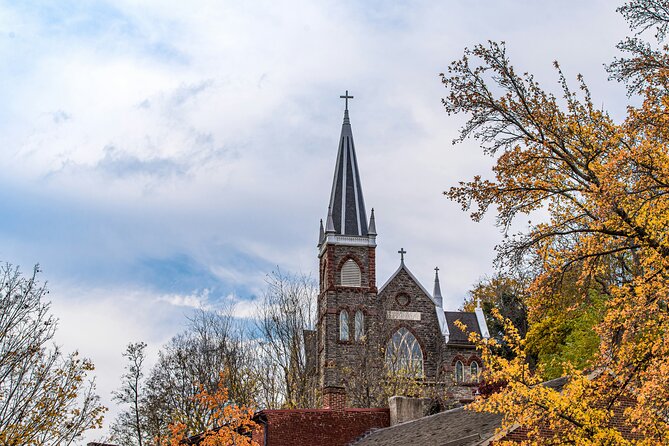
St. Peter’s Roman Catholic Church adds another layer. This stone church served Irish immigrant families and survived the Civil War. Its hillside position gives it a strong visual presence, while the story of sanctuary and endurance connects the building to the town’s immigrant and religious life.
More go-at-your-own-pace island days in the USA:
- Fort Sumter Admission and Self-Guided Tour with Roundtrip Ferry
★ 4.5 · 3,343 reviews - San Francisco: Alcatraz Ticket, Ferry, & Self-Guided App
★ 4.5 · 2,460 reviews - San Francisco: Alcatraz, Ferry & Audio Tour w/ Night Option
★ 4.4 · 617 reviews - San Francisco: Self-Guided Bike Rental
★ 4.7 · 161 reviews
John Brown’s Fort and the armory ruins

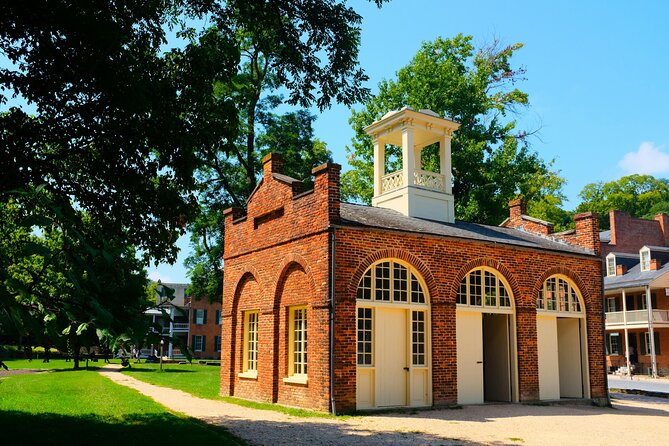
John Brown’s Fort is the emotional center of the tour. This small brick fire engine house became John Brown’s last stronghold during his 1859 raid. Brown hoped to seize weapons and spark an uprising against slavery. The raid failed militarily, but it helped push the country toward the crisis that led to the Civil War.
The fort is modest in size. That is part of its power. You are not looking at a grand battlefield monument. You are looking at a small building where a major national conflict came to a head.
Nearby, the US Armory Site and Arsenal Square show the setting Brown targeted. The armory was once a major weapons factory, but today only foundations remain in some areas. The ruins require imagination, which is where the audio works well. It supplies the missing scale and context while you look at the ground under your feet.
Give these stops time. The listed listening time is short, but you may want to pause and read signs, take photographs, and picture the buildings that once filled the area.
Jefferson Rock and the view over Harpers Ferry
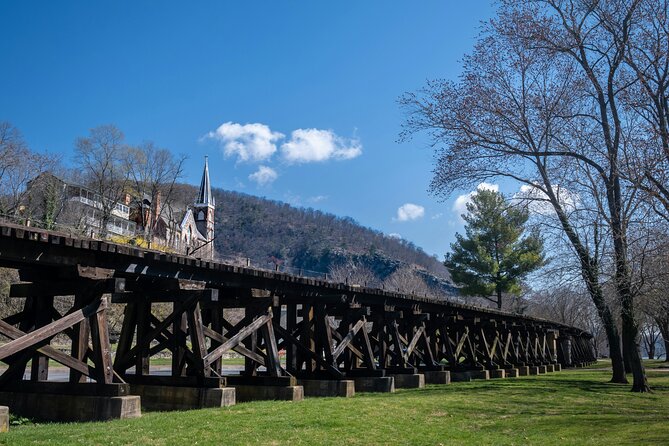
Jefferson Rock is one of the best-known viewpoints in town. Thomas Jefferson admired the spot, and the cliffside perch lets you look across the rivers and surrounding ridges.
This is not just a quick photo stop. The view explains Harpers Ferry’s geography. The Potomac and Shenandoah Rivers meet here, creating a natural crossroads. The water brought transport and power, while the narrow valley and surrounding heights gave the town military importance.
The route’s audio format suits this kind of stop. You can listen, then look outward while the story is still fresh. One of the strengths of the tour is this combination of past and present. You hear about an event, then stand in the place where the terrain helped shape it.
The Point and the original ferry crossing
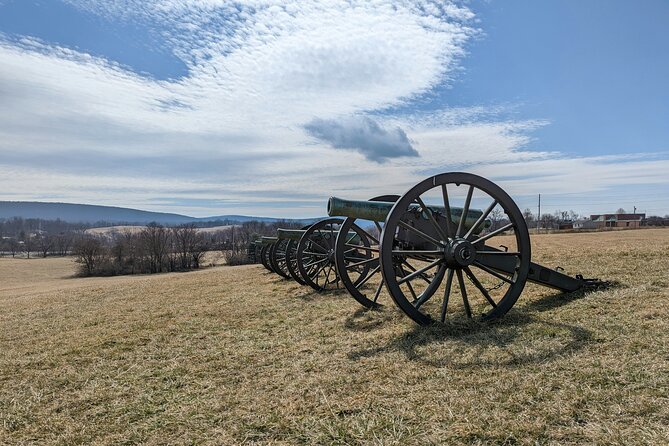
At The Point, you reach the meeting place of the Potomac and Shenandoah Rivers. The view is dramatic, but the real value is understanding the town’s position. Trade, transportation, and military strategy all focused on this narrow meeting of waterways.
The tour also identifies the original site of the Shenandoah River Bridge and the place connected to Robert Harper’s 18th-century ferry. That ferry helped start the settlement that became Harpers Ferry.
These stops work best together. The ferry explains how people first crossed and traded, while The Point explains why the town continued to matter. You can see how a small crossing grew into a major crossroads of commerce and conflict.
Virginius Island and the remains of industry
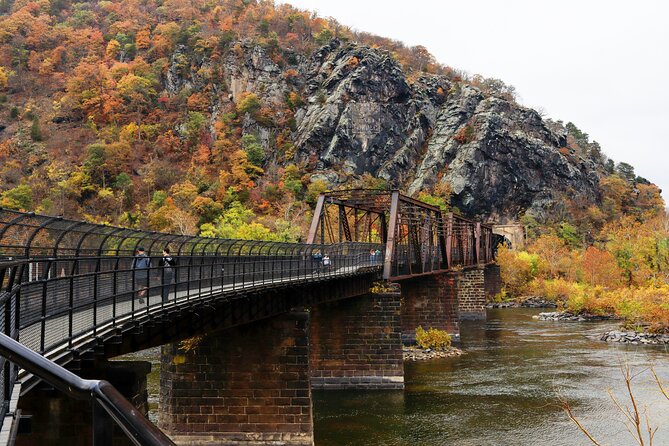
Virginius Island offers a different side of Harpers Ferry. Today it is a quiet wooded area with ruins and trails. In the past, it was an industrial village powered by the rivers.
Moss-covered remains can be easy to overlook without explanation. The audio helps you read the foundations, channels, and scattered traces as part of a former working community. This is one of the more atmospheric parts of the route, but it may also be less satisfying if you prefer intact buildings and clear displays.
The industrial story matters because Harpers Ferry was not only famous for politics and war. Water power supported manufacturing, and the town’s economy rose and fell with those industries. Virginius Island shows the physical remains of that change.
White Hall Tavern and Harpers Ferry’s public life
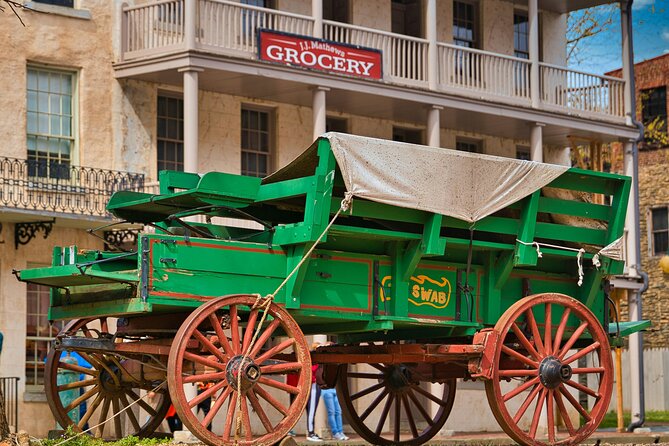
White Hall Tavern gives you a glimpse of everyday life. The 19th-century tavern served travelers, local people, and Union soldiers. Taverns were places to eat and drink, but also places where news, arguments, and politics moved from one person to another.
This stop helps break up the larger military and political stories. It reminds you that Harpers Ferry was a lived-in town, not simply a stage for famous events.
Harpers Ferry Public Square continues that civic theme. Markets, parades, protests, and militias have all passed through this central space. Today, the square remains a natural place to pause, orient yourself, and watch the town around you.
Murphy Farm and Bolivar Heights
Murphy Farm carries two very different memories. It was once a battlefield and later a setting for important civil rights speeches. The open setting makes it a useful place for reflection, with broad views and fewer buildings to distract you.
Bolivar Heights is another overlook with a military focus. The ridge was fought over repeatedly during the Civil War because controlling the high ground meant controlling access to Harpers Ferry.
These stops may require extra effort depending on the exact walking route and your pace. They also make clear why the tour can take around two hours, or longer if you stop often. The audio itself may be manageable in that time, but photographs, museum pauses, and uphill walking add to the day.
How the app works in real life
The app’s location feature is the tour’s strongest practical tool. When you reach a site, the narration can begin automatically. You can walk at your own speed, stop to read historical markers, and continue when ready.
The interface is not perfect. The map is available through a button at the bottom of each screen, but it is not always obvious at first. Map locations could also be labeled more clearly. You can technically begin at another point, but the story makes the most sense in its intended order.
I suggest opening the app before you leave your lodging, checking the map, and starting at the train station. If you need to skip a hill or shorten the walk, you can still use the audio at individual locations, but the narrative will be less tidy.
Bring your own charged smartphone. The tour includes the app download, audio guide, and unlimited access, but not a phone. Children age 10 and younger are free.
Is $9.99 a fair price?
At $9.99 per person, this is a good-value choice if you want more than a map and less than a private live tour. You get coverage of 19 sites, a planned route, and narration that adds meaning to ruins and overlooks.
The value is strongest for a first visit. Harpers Ferry can feel confusing because its attractions are spread between Lower Town, hillsides, old industrial areas, and viewpoints. The audio gives you a framework so the pieces fit together.
The price is less attractive if you only want to see Lower Town for an hour or if you already know Harpers Ferry well. It also does not replace entry to any museum, and the African American history museum is currently closed for renovations.
Free cancellation is available if you cancel at least 24 hours before the start time. Cancellations within 24 hours are not refunded.
Who should book this walking tour?
I would choose this tour for independent visitors who like history, photographs, and the freedom to pause often. It suits couples, families with older children, and small private groups that do not want to follow a live guide.
It is especially useful if you want several subjects in one walk: John Brown, the Civil War, Black education, railroads, industry, religion, the Appalachian Trail, and the rivers.
I would think twice if steep hills are a serious concern. One person stopped before finishing because of the uphill sections, and another found the attractions too spread out for an easy walk. The tour is not a trolley ride, and driving between stops is not a simple solution either.
Should you book the Harpers Ferry audio tour?
Book it if you want a low-cost, self-paced introduction to Harpers Ferry and are comfortable walking hills and stairs. The automatic location prompts, wide range of subjects, and river views make it more useful than a simple audio recording.
Skip it if you need a fully accessible route, prefer a live guide, or only plan a short visit to Lower Town. If you do book, download everything before arriving, start at the train station, and allow more than two hours if you like to read markers and stop for views.
FAQ
Where does the Harpers Ferry audio tour begin?
It begins at the Lower Town Train Station, 182 Potomac Street, Harpers Ferry, West Virginia 25425.
Where does the tour end?
The activity ends back at the meeting point near the Lower Town Train Station.
How long does the audio tour take?
The estimated duration is about two hours.
How much does the tour cost?
The price is $9.99 per person.
Is the tour available every day?
Yes. It is offered Monday through Sunday from 8 a.m. to 8 p.m. during the listed operating period.
What language is the audio guide in?
The tour is offered in English.
Do I need to bring my own phone?
Yes. A smartphone is not included, so you need to bring your own device.
Should I download the tour before arriving?
Yes. Cell service is described as spotty at best, so download the app and tour content before you go.
Are children charged for the tour?
Children age 10 and younger are free.
Can I cancel for a full refund?
Yes, if you cancel at least 24 hours before the experience start time. Cancellations within 24 hours are not refunded.
More audio tours in the USA
- Alcatraz Inside Access Ferry and Audio Tour with Night Option
★ 4.0 · 138 reviews - Gozo Day Pass Ferry and Hop-on Hop-off buses with audio Tour
★ 3.0 · 19 reviews
Latest sailings added in the USA
- NYC: Brooklyn Bridge and DUMBO Tour with East River Ferry★ 4.9 · 28 reviews
- Old Town Alexandria in a Day with Round Trip Ferry Cruise★ 4.5 · 17 reviews
- City Tour with Food Stop at Ferry Building + Optional Alcatraz★ 5.0 · 79 reviews
- Explore Olympic National Park from Seattle through Van /Ferry★ 4.0 · 21 reviews
- Sausalito Ferry from Pier 41, San Francisco★ 4.0 · 74 reviews
- San Francisco Food Tour: Ferry Building and Ferry Plaza Farmers Market★ 4.5 · 92 reviews
- San Francisco Alcatraz, Ferry and 2 Day Hop On Hop Off Bus Tour★ 3.0 · 2 reviews
- Muir Woods and Sausalito + Ferry, Alcatraz Night Tour & Aquarium Access★ 4.0 · 3 reviews
Historical Tours, compared.

Boston Historic Taverns Tour with Tastings and Ferry
Read our review →
Boston: Historic Pubs Walking & Ferry, Food & Drink Tour
Read our review →
Halifax: Georges Island National Historic Site Ferry Ticket
Read our review →
Batam Heritage Tour with Singapore Ferry Ticket, Lunch & Massage
Read our review →Find it on these lists